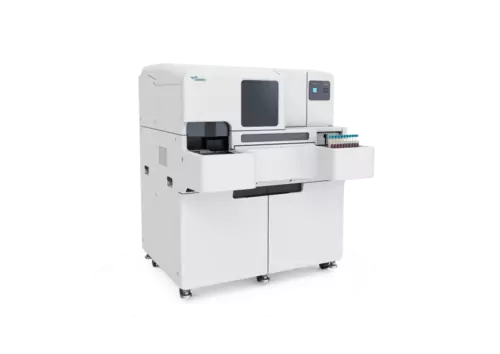
CS-5100 outstanding haemostasis analysis
Simply, safely and speedily - outstanding haemostasis analysis
Exceptional throughput of up to 400 tests per hour with gold standard results
Efficient and productive, with remote access and LAS compatible
Superior calibration and assay performance
Pre analytical sample integrity check (HIL)
Powerful multi-wavelength technology - clotting, chromogenic, immunological and platelet aggregation methods
The CS-5100 is a superb haemostasis analyser. With a throughput of up to 400 tests per hour, it delivers high quality results in a very short timeframe. With its powerful multi-wavelength technology, it has 20 channels for clotting, chromogenic and immunoassays and eight for platelet aggregation with automatic stirring. The device also checks automatically for interfering substances (HIL) and can be run in random access with other assays.
We have also focused on making the device easy to use, flexible and productive for you. Pre-analytical sample checks mean you no longer need to check manually, it offers remote access and it is easy include in larger laboratory solutions. Advanced reagent management makes use of simplified software, and an auto QC on vial change significantly diminishes the risk of errors. A great device, easy to use and as accurate as they come.
*Technical Specifications :
-Detection principles : multi-wavelength detector for transmitted light at / 340, 405, 575, 660 and 800 nm
-Detection methods : 20 channels for clotting, chromogenic and immunoassays / 8 channels for platelet aggregation
-Parameters : up to 60 parameters can be analysed simultaneously
-Throughput : up to 400 tests/h
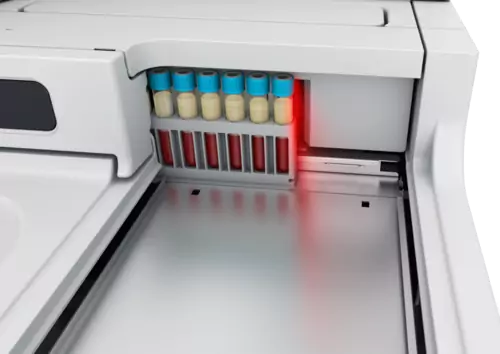
-Sampling : rack type, auto sampler, cap piercing functionality, initial capacity for 10 racks with 10 sample / tubes each, continuous loading possibility, separate STAT positions / direct sampling (optional) to connect the CS-5100 via its left side to a lab automation transport system
-Reagent holder : 40 positions cooled at 10 °C / 5 positions at room temperature / all positions with positive reagent identification
Reference curves:multi-lot management with max. 10 curves/reagent lot
and max. 10 reagent lots/parameter
-Quality control : x-bar, Levey-Jennings and Westgard control / 750 parameter files with max. 1,200 data points each
-Data storage : up to 10,000 samples
-Dimensions/weights :main unit* / IPU with cabinet / w x h x d [mm] / [kg] / approx. 1030 x 1280 x 1150 / 278 / approx. 500 x 920 x 890 / 67
*excluding optional features, such as direct sampling, which will alter the dimensions.
No compromise on quality
Using four different detection technologies, the CS-5100 delivers great quality analyses. With clotting, chromogenic, immunoturbimetric and platelet aggregation assays it delivers accuracy and precision for all parameters
Clotting method
The CS-5100 uses the Optical Detection Method to detect the change in turbidity of the sample-reaction mixture during the coagulation process. This is reflected in the change in scattered light intensity when fibrinogen is converted into a fibrin mesh. Light strikes the reaction mixture, after the scattered light intensity is received by a photodiode. This converts the light intensity into electrical signals and is used to find the haemostasis time. This method is used to measure prothrombin time, APTT, fibrinogen, factors and many other clotting tests.
Chromogenic method
Light with a wavelength of 405 nm passes through the sample and reagent mixture and reaches a photodiode, where the transmitted light is converted into electrical signals. The change in the intensity of this transmitted light is used to determine the change in absorbance. This measurement is used for chromogenic assays like Antithrombin and Protein C where a chromogenic substrate in presence of an activator causes the reagent mixture to change colour.
Immunoassay and platelet aggregation method
The sample-reagent mixture contains artificial particles that can aggregate when there is an antigen-antibody reaction or particles that have a natural capability to aggregate like platelets. The mixture is exposed to light of a high wavelength, and the change in light absorbance caused by the formation of aggregates is detected as the change in transmitted light. This is used for D-dimer assays and platelet aggregation assays (Von Willebrand activity, ADP, Collagen, Arachidonic Acid, Epinephrine).
Get it right before you start testing – pre-analytical sample integrity helps
Pre-analytical issues can account for as much as 70% of a clinical laboratory’s errors. Multi-wavelength scanning and sample liquid-sensing technologies detect unsuitable specimens. A pre-analytical sample integrity check tests for interfering substances in the sample – haemolysis, icterus, lipaemia – at three wavelengths: 405 nm, 575 nm and 660 nm.
A primary tube sample volume check provides assistance by identifying potential inaccuracies caused by improper sample collection, which can result in an incorrect ratio of anticoagulant to patient plasma.
Under specific conditions, the CS-5100 will automatically use the optimal wavelengths to ensure result accuracy in the presence of hemolysis, icterus or lipemia. This minimises the need for retesting and helps you deliver the highest quality results on your first test run.
Multi-wave detection - reduce your repeat tests
Using a multi-wave detection system, the CS-5100 can simultaneously measure multiple parameters using four different measurement methods: haemostasis, chromogenic, immunoassay and aggregation. The system’s photo-optical clot detection means you have several advantages compared to mechanical detection.
You can measure light transmittance over the entire course of clot formation, not just the end.
You can identify atypical reaction patterns easily and so determine the correct haemostasis reaction result for your patients with unusual in vitro clot reactions such as sepsis and DIC.
The clotting reactions display the complete clot signature, not just a single data point, so that you get far more detailed test information and therefore better clinical utility.
Used on a single platform, the broad range of assays allows high test throughput – up to 400 samples per hour.